

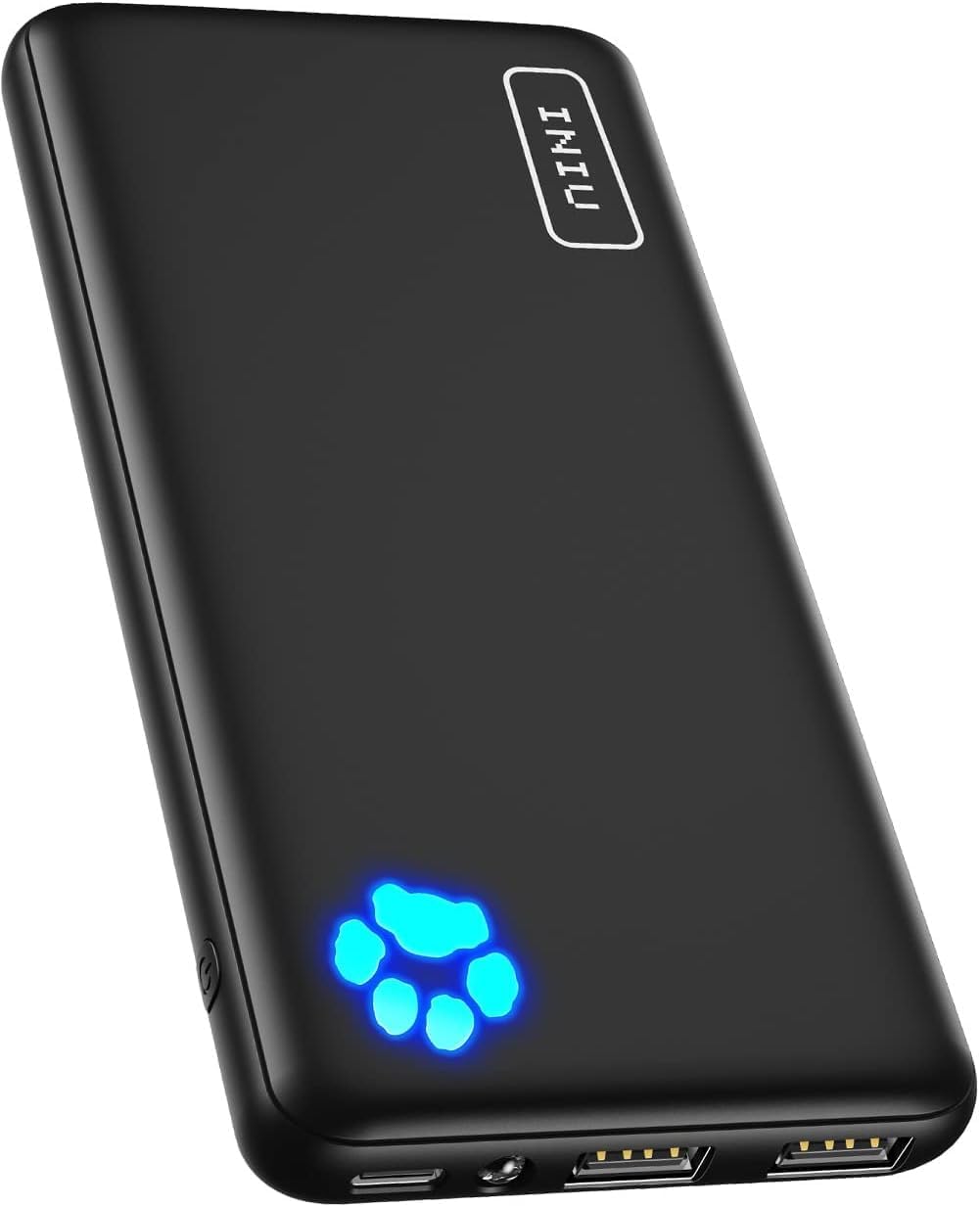
Portable Charger 50000 mAh Power Bank PD 30W and QC 4.0 PowerBank Fast Charging External Battery Pack with USB-C LED 3 Outputs & 2 Inputs Portable Charging for iPhone 15 14 13 pro, Samsung
Original price was: $39.99.$27.99Current price is: $27.99.


Price: $39.99 - $27.99
(as of Oct 12, 2025 09:48:11 UTC – Details)
Product description

The video showcases the product in use.The video guides you through product setup.The video compares multiple products.The video shows the product being unpacked. Power bank 50000mAh Merchant Video

 4 Outputs
The external battery pack for your phone features 1 USB-C port and 3 USB-A ports, offering versatile convenience for more charging options.
 2 Inputs
Our Enerwow power bank also includes multiple input ports for charging devices, making it easy to recharge the power bank itself.


 Home Applications
When you’re worried about your phone running out of battery while gaming, our Enerwow power bank eliminates that concern—charge and use anytime.
 Outdoor Applications
Worried about your phone running out of power outdoors? Our portable power bank delivers long-lasting battery life to keep you powered up.
 Digital Display
No need to worry about your power bank’s remaining charge—our power bank features a digital display that shows your battery status at all times.
 Multi-Functional
Whether it’s your phone, tablet, or headphones, this power bank handles it all with ease, ensuring your devices stay fully charged at all times.
[Portable Charger 50000mAh] : Enerwow power bank with the high capacity, you can charge your iphone smoothly. It offers 11 charges for iPhone 13 Pro, offers 8 charges for Samsung Galaxy S22.
[PD 30W Fast Charging] : Battery pack with the upgraded PD 30W output and the latest QC4.0 fast charging technology, it can charge your iPhone to 55% in just 30 minutes.
[4 Outputs & 2 Inputs]: Mobile phone external battery pack is equipped with 1 USB-C interface and 3 USB-A interfaces, and also has an input interface that can charge 4 devices at the same time!
[Universal Compatibility] : Cell phone battery pack widely compatible with iPhone, Samsung, Google Pixel, Xiaomi smartphones and other devices such as earbuds, fitness, smartwatch, gopro camera. for iPhone 14 ,14Pro MAX,13,12, iPadair, Airpods, Samsung, Huawei and more.
[Safety Protection]: Multiple protection systems can fully protect your device and keep your power bank healthy, including overcharge protection, short circuit protection, overvoltage protection, overcurrent protection, etc.
Customers say
Customers praise the power bank’s capacity of 40,000mAh and its ability to charge multiple devices simultaneously, considering it well worth the price. The functionality and charging speed receive mixed feedback – while some find it works well and charges quickly, others report it stops working and takes a while to fully charge. The weight and capacity are also mixed aspects, with some finding it lightweight while others consider it heavy, and some noting it’s not 40,000mAh as advertised.
8 reviews for Portable Charger 50000 mAh Power Bank PD 30W and QC 4.0 PowerBank Fast Charging External Battery Pack with USB-C LED 3 Outputs & 2 Inputs Portable Charging for iPhone 15 14 13 pro, Samsung
Add a review
Related Products


Original price was: $39.99.$27.99Current price is: $27.99.

AnXRockStar –
A Bit Pricey, but Worth It
I accidentally ordered a photography light thinking it was an emergency light. (We had some wiring issues and repair required shutting down several times for a few hours) I’m a bit of a shutterbug, so not a complete waste, but I did need a portable power solution.I picked these (I got two, different colors, because for some reason the deal doesn’t apply to two of the same) because continuous lighting takes gobs of power… well, for USB at least, and these not only had a high storage rating, but a high continuous rating as well.Using it to power the light, I was able to get full power with no issues. Backed off a bit, (not calibrated so I’m not sure how much) and I got about 4 hours of light from one pack. And this was room filling-light, not like a flashlight, even at the reduced power I was using. Not bad at all!As far as using it as a charger goes, one full charge was able to fill two phones and tablets without any complaint, with plenty of charge left. Definitely work well for a weekend outing.Minor but useful details, they’re roughly shaped like a very thick smart phone so easy to pack. They also can be used while connected to a charger, so if there’s only one port in the back seat and two kids with tablets it doubles as a Y adapter. (Obviously without data so no Bluey and Ms Rachael mashups over the stereo. ð) They can be charged with either USB C or µ-USB, although that one takes aeons. (That goes for any high capacity pack.)Bottom line: compared to the supermarket checkout impulse buy units, they’re A Bit Pricey, but Worth It.
Joe –
Power for days
Bought this to go on a trip on the motorcycle and camp at the destination for a few days. The amount of battery this has is impressive. The size of it is bulky, but it is worth it. It fast charges as well. I was able to charge a phone a few times and then also charge a computer halfway and still have some left over, so it has power to last. It does take quite a while to charge, but as long as you get it charged, it will last for a good long time. It has a USB-C, micro USB, and two large or USB-A ports, so it will work on just about anything. One other note I have felt it through out the charging and did not feel any heat coming off of it.
Karose1664 –
Great Charger, Lasts Forever
This has to be one of the best portable chargers I have bought so far! It charges my iPad to 100% while I am using it with life to spare, I have taken it on vacation to charge my phone and watch because there are never enough plugs in the room or they are not convenient. It stays at 100% once charged until you need it, even if it is months down the road.Please keep in mind, this âportableâ power bank is a normal size for 40,000, it is heavy and not going into a purse or my backpackâmy 10,000 is plenty big for emergency use/quick charge for my phone. This power bank also takes a good amount of time to fully charge once drained. You also need a decent charging block (USB C) to charge the power bank itself. I would definitely purchase again, it would also make a great gift!
Ryan –
Ive got the power! … eventually
Great product, can power a InstaX4 for hours of timelapse recording.Takes forever to recharge though.
Amazon Customer –
Super capacity, can take on airplane, and we’ve had the ability to charge when needed.
This is our 2nd one – first one went with my wife on a hiking trip across Spain, and it was a lifesaver. The other one went with my son over the summer as he was a Ranger at Philmont high adventure camp. I would definitely buy this again.
Moonfrost –
Great Power Bank! Charges fast!
This power bank is great! It charges fast! I can charge my phone several times with this before it needs a recharge. The only down side is, it’s a little heavy, but I guess that’s the price you pay for all the extra power. I’m going to buy some for gifts.
Noah’s Ark –
Scam Battery Pack! Tested output power capacity is only 50% and max 20W output on USB-C port.
Don’t waste your time and money on this scam product! This 30W 40,000mAh power pack is at best a poorly functioning 22.5W 27,000mAh power pack in disguise and its total output capacity is 10% less than better quality units like the “Imuto 30W 27000mAh Power Bank”!I should have believed the negative reviews instead of wasting all of this effort only to end up adding yet another detailed negative review to the list! Of course it’s possible I received a bad unit just like all the other folks who generated negative reviews about its performance. On the other hand, maybe we are the only ones that actually ran measured tests and discovered this product was really a scam.Details:The Enerwow power pack is labeled as 40,000mAh capacity which gives it a 148Wh power rating (the industry standard formula for lithium power packs is: Wh = Ah * 3.7V). But my unit really only stores 108Wh of input power (equivalent to 29,190mAh labeling, 27% less than 40,000mAh) and only produces 75.8Wh total output power (equivalent 20,486mAh labeling, almost 50% less than 40,000mAh). The average of the input and output power values is what is considered the fairest rating of a power pack and in this case it would be 91.9Wh which has an equivalent labeling of 24,837mAh. This means it is behaving like a 38% LOWER CAPACITY power pack with a 25,000mAh capacity rating, not the 40,000mAh it claims to be! It only has a maximum steady output of 20W on the USB-C port when it is the only one used, not the steady 30W it claims to provide. To make things even worse it does almost all of its recharging at only 14W input and takes over 7 hours to fully recharge despite its lower capacity!The measured output wattage and total power input/output capacity are at the very bottom range of a very poorly functioning 22.5V 27,000mAh power pack and its total output capacity is 10% less than better quality units like the “”Imuto 30W 27000mAh Power Bank” (see Imuto details bellow)! In fact, it performs closer to a properly working 20W 25,000mAh power pack!Note: This power pack would not be allowed as passenger airplane carry-on luggage (no power packs are allowed at all as checked luggage). The FAA regulations only allow carry-on lithium power packs with a capacity of 100Wh or less, the equivalent to a labeling of 27,027mAh or less. Even though this Enerwow power pack has 10% less output capacity than a quality 27,000mAh labeled power pack, it would not be allowed as carry-on because its labeling claims 40,000mAh capacity.Summary:This 30W 40,000mAh capacity power pack is functioning more like the equivalent of a 20W 25,000mAh power pack! I would not be surprised if the internal component was really a working but QA rejected 22.5W 27,000mAh power unit in disguise with a throttled down input wattage that fools unsuspecting owners by taking as long to recharge as a typical 40,000mAh unit. Most owners would be so happy with the price they paid that they wouldn’t even notice how poorly it functions when charging devices. When compared with the Enerwow “Product Description” claims, this product is a scam that relies on customers not noticing the difference!Test Equipment:I used a “Kowsi KWS-066C Digital ” USB Power Multimeter to measure the total input/output Watt-Hour power capacity and real-time Wattage of this power pack. After an initial full charging of the power pack to 100% and verifying the input wattage was down to 0W, I tested a complete discharge and recharge cycle. To drain the power pack (output) I used a Lenovo ChromeBook laptop with “Adaptive Charging” disabled and did as many laptop 10%->90% charging cycles as needed. To recharge the power pack (input) I used a 65W USB-C PD (Power Delivery) charger. To connect these two to the power pack I used a 100W rated USB-C PD-2.0 cable with the USB power meter in-line (the USB meter is rated at a maximum 195W). Note it is important to use an appropriate wattage-rated USB-C cable for testing that supports the PD-2.0 specification or else the cable’s internal microchip may throttle the wattage throughput to a lower value (Yes, any USB-C cable that supports 25W or higher must have an internal “E-Mark microchip” that specifies its wattage rating or, if the chip is missing, typically only 24W will be the maximum power pushed into the cable!).Power Pack Nerdy Details:(Skip this section unless you are extremely nerdy or bored!)Watts (Wattage = Amperage x Voltage) are a measure of “electrical power” being used at the moment and Watt-Hours are a measure of total electrical power capacity (total amount of electrical power used or stored over a period of time). Watt-Hours are used to measure the power capacity of systems like solar panels, storage battery systems, laptops, and electric vehicles. Watt-Hours, not Amp-Hours, are the only correct “measure” of power capacity for modern power packs which provide variable output voltage and amperage. For example, 10,000mWh of output power capacity can be generated by either “1,000mAh x 10V” or “2,000mAh x 5V”. If you used a USB power meter to only measure the mAh output of a power pack and didn’t factor in the voltage it was producing, you would incorrectly conclude the power pack that measured 2,000mAh had 2x more power capacity when in fact they both have the same power capacity. If instead you used the USB power meter to measure mWh you would see they both produced the same 10,000mWh of output power.The reason typical batteries are only labeled with their Amp-Hour capacity rather than also including their Watt-Hour capacity as a measure of their “electrical power” is because batteries of the same type all have the same constant voltage (e.g. 1.5V, 3.7V, 9V, etc.) and the only component that varies the power capacity is the Amp-Hour. Amp-Hour labeling provides detailed technical information about a battery’s total measurable amperage but can also be used to compare the relative power capacity of batteries of the same voltage. For example, the relative power capacity of all 1.5V batteries can be compared by simply comparing their labeled mAh capacity rating. However, if you want to compare the power capacity between different battery types, for example a 1.5V vs a 9V battery, you cannot just use their labeled Amp-Hour capacity for comparison. You need to multiply their Amp-Hour capacity by their respective voltage to get their true Watt-Hour capacity for a proper comparison. Likewise, modern power packs are not constant voltage/amperage power sources (though they may internally be made up of battery cells) and Watt-Hours is the only correct true measure of their power capacity.Nevertheless, the typical retail consumer thinks of power packs as if they were big “smart batteries” and they are accustomed to thinking about battery power capacity in Amp-Hours, not Watt-Hours. The power pack manufactures make it easy for consumers to use Amp-Hours in evaluating the total power capacity of their products by adopting an industry standard Amp-Hour rating system. All power pack manufactures label the power capacity of their products using this Amp-Hour rating system and typically only specify the true Watt-Hour capacity of their product in the fine print of their technical specifications. Since 3.7V is the industry accepted standard for the constant voltage of traditional rechargeable lithium batteries like the #18650 battery (larger than a AA battery), they make believe their power pack behaves like a big 3.7V lithium battery. They then calculate what labeled Amp-Hour value would make a constant 3.7V battery have the same total Watt-Hours as their variable voltage/amperage power pack. The labeling formula is “Ah = Wh / 3.7V” and for example a 100Wh power pack would be labeled as 27,027mAh (27,027mAh = 100,000mWh / 3.7V). Note if they had chosen a higher voltage standard, e.g. 5V, the labeled Amp-Hour capacity would be a smaller value.A benefit of using a 3.7V based Amp-Hour capacity formula is that the labeled power pack mAh capacity can now be directly compared to the mAh capacity of standard rechargeable cellphones, which are also labeled according to this 3.7V lithium battery Amp-Hour rating system. In theory this makes it very easy to evaluate how many times a fully charged power pack can recharge your cellphone. However there is a difference in the Watt-Hours required to charge a power pack (input) and the Watt-Hours a power pack can provide as output. There typically is a normal 30% loss of power output due to expected heat and electrical inefficiency in inexpensive low quality power pack internal rechargeable batteries. The fair rating would be to label the mAh capacity of a power pack as the average of these two numbers but many power pack manufactures instead label their product much closer to the higher input capacity number so that their product advertising stands out. This means the effective power input capacity required to fully charge a completely drained power pack may be as high as 115% of its rated power capacity and its effective total power output capacity is often less than 85% (the worst case being 70%). This input/output capacity difference also applies to the rechargeable cellphones themselves but in their case they use very high quality rechargeable batteries that at most have 15% inefficiency. You need to factor in both the smaller effective power pack output capacity and the typically required ~107% cellphone recharge input capacity when evaluating how many times a power pack can recharge a cellphone.It is important to realize the labeled power pack mAh value will always be significantly greater than the total mAh that would ever be measured by a USB power meter because the minimum power pack output USB system voltage is 5V, not 3.7V, and the power pack will be varying the output voltage to much higher levels while the variable amperage electric current is flowing. The higher the output voltage, the lower the measured output mAh. Unlike batteries, this labeled mAh value is not the real total “measurable” mAh of the power pack; it is only a number to be used in “comparing the relative total capacity” of power packs and cellphones. But it can also be used to calculate the true corresponding Watt-Hour rated capacity of a power pack by using the formula “Wh = Ah x 3.7V”. For example this Enerwow 40,000mAh labeled power pack does not state its rated Watt-Hour capacity anywhere at all (a clue it might be a shifty product), but nevertheless we know it should have a rated 148Wh of total power capacity (148,000mWh = 40,000mAh x 3.7V). This 148Wh rating can be verified by using a USB power meter to measure the total output Watt-Hours required to fully drain the power pack and how many input Watt-Hours are required to fully recharge the power pack.Test Result Details:The measured Enerwow total output power capacity is 75.8Wh (equivalent to a 20,486mAh labeling) which is only 51% of the claimed 148Wh rating. If it really did have the 148Wh fair-averaged capacity rating, 125.8Wh output would have been expected (125.8Wh = 148Wh x 85%) and 75.8Wh is an OUTPUT 40% LOWER THAN EXPECTED! The worst problem was that, though the maximum single port UBC-C output wattage would start at 30W, it would quickly drop to a steady output of only 20W and so it takes a longer time to recharge a large power capacity device like a laptop.Recharging the drained Enerwow to 100% only took 108Wh of input power (equivalent of a 29,190mAh labeling) which is only 73% of the claimed 148Wh capacity rating. If it really did have the 148Wh fair-averaged capacity rating, an input of 170.2Wh would have been expected (170.2Wh = 148Wh x 115%) and 108Wh is an INPUT 37% LOWER THAN EXPECTED! Despite this lower input capicity, it took much longer than it should have to recharge because, though it begins recharging at 20W, it very quickly only uses a maximum of 14W input. It took almost 6 hours for the drained power pack to reach 80% full and 7.5 hours to fully recharge.The correlated significantly lower 75.8Wh output and 108Wh input power capacities means the Enerwow really does have the standard 30% power loss inefficiency (75.8Wh-output â 108Wh-input x 70%). The average of its input and output capacity values would give it a fair capacity rating of 91.9Wh which has the equivalent labeling of 24,837mAh and is a CAPACITY 38% LOWER THAN CLAIMED. This means this power pack is functioning more like A POWER PACK RATED AT 25,000mAh CAPACITY, not the 40,000mAh it claims to be!Test Conclusion:The maximum steady output wattage and total Watt-Hour input/output capacity of this 30W 40,000mAh power pack is similar to either a poorly functioning 22.5W 27,000mAH power pack or a properly functioning 20W 25,000mAh power pack. Despite its lower 38% capacity, it has a throttled 14W input that takes as long to recharge the power pack as if it deceptively was a 40,000mAh (148Wh) power pack recharging at 20W!Imuto 30W 27000mAh:My old heavy and bulky power pack is a “Imuto 30W 27000mAh Power Bank” and I wanted a lighter and smaller unit that had at least 40% more capacity. The Enerwow claims 40,000mAh capacity (48% more), weighs almost 30% less, and is a physically smaller size. But the 40,000mAh Enerwow power pack only produces a steady 20W output and ends up having 10% less total output capacity than the 27000mAh Imuto!The 27,000mAh Imuto is explicitly labeled right on the unit as having 99.9Wh capacity. My unit has a measured recharge input capacity of 118Wh (equivalent to 31,892mAh labeling) and an output capacity of 85Wh (equivalent to 22,973mAh) which is a 28% inefficiency loss. Its rating is very close to the average of the measured input and output values (27,433mAh) and its measured 85Wh output is the expected standard 85% of its labeled rating. It has a maximum consistent output of 30W on the USB-C port when it is the only one used. It recharges using 30W input and only reduces the input to 14W when above 90% full and then finally a trickle-recharge to protect the power pack battery life. Because the Imuto is labeled as only 99.9Wh power capacity, the FAA allows it on commercial airplanes.
Steve V –
Incredible power!
I bought tis for a relative and they like it a lot. It was for a cell phone that had trouble charging the traditional way and needed that extra boost. It works like a charm for that and all the other devices as well.