

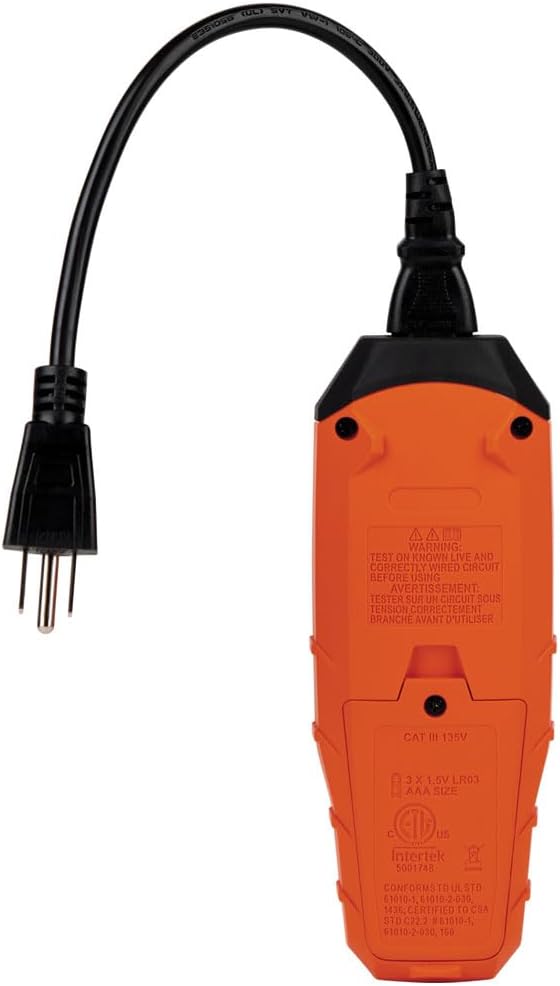
Klein Tools RT390 Circuit Analyzer with Large LCD, Identifies Wiring Faults, GFCI and AFCI Tester, Voltage Drop, Displays Trip Time
$159.99



Price: $159.99
(as of Oct 07, 2025 07:49:14 UTC – Details)
The Klein Tools RT390 is a Circuit Analyzer that tests the wiring conditions at an electrical outlet, displays AC line voltage, inspects AFCI and GFCI devices with time to trip device, and performs voltage drop tests at 12A, 15A and 20A current loads. Results are easy to understand with large, color LCD. The tester is designed for use with North American 120V AC 3-wire electrical outlets. For more than 160 years, Klein Tools has manufactured premium-quality, professional-grade hand tools that deliver the performance, durability and precision needed to get the job done right. Our family of engineers, workers and craftsman continue to put six generations of expertise into every tool we create by using only the highest quality materials, superior workmanship, and keeping manufacturing as close to home as we can. Klein isn’t just the name of our company, it’s also our family name. And since we’re an American company that’s family-owned and family-run, you know you can count on us to be here tomorrow. Klein Tools doesn’t just make great products, we make great products that stand up to the demands of the professionals who use them every day … Since 1857.
CLEAR COLOR LCD DISPLAY: Circuit Analyzer with large color LCD provides easy-to-understand results for wiring faults, AFCI, GFCI, voltage drops, and device trip time
COMPREHENSIVE WIRING FAULT DETECTION: Detect and identify common wiring faults in standard, AFCI, and GFCI electrical outlets, ensuring thorough evaluation
DUAL WIRING FAULT DETECTION: Capable of detecting dual wiring faults, including open neutral and open ground, enhancing safety measures
AFCI AND GFCI DEVICE INSPECTION: Inspect AFCI and GFCI devices, measuring trip time and trip current for accurate functionality assessment
LOAD TESTING CAPABILITIES: Conduct 12A, 15A, and 20A load testing to measure percentage voltage drops, providing valuable insights into electrical performance
AUTO POWER OFF: Automatically powers off after 5 minutes of inactivity, conserving battery life and ensuring long-term usage
DETACHABLE CORD: Detachable cord allows for easy storage, providing convenience and organized handling of the Circuit Analyzer
Customers say
Customers find the circuit analyzer to be a useful tool that works well for testing home outlets and offers additional GFCI testing options. The display is easy to read, and customers consider it good value for money. While the functionality and ease of use receive positive feedback, customers have mixed opinions about the device’s bulkiness and voltage drop measurements.
11 reviews for Klein Tools RT390 Circuit Analyzer with Large LCD, Identifies Wiring Faults, GFCI and AFCI Tester, Voltage Drop, Displays Trip Time
Add a review
Related Products


$159.99

Jeff C. –
Great for checking receptacles for more than just correct wiring
I got the Klein RT390 mainly to look at voltage drop; I have one GFCI outlet and no GFCI or AFCI breakers. Given that, I probably didnât stress the analyzer as much as some of the other reviewers did. Iâm also not a practicing electrician, so I havenât given the unit heavy use. My rating is based on using it only a few times, and itâs something I probably wonât be repeating on a daily basisâso I cannot really comment on reliability.The RT390 greatly simplifies measuring voltage drop by giving results at three different loadsâ12 A, 15 A, and 20 Aâwith the press of a button. The results are displayed for five minutes, even if the cable is disconnected, so itâs easy to take the analyzer to a computer to record the results; I put them into a spreadsheet that does some additional calculations, like estimating the length of the circuit under test.Detachable CableThe detachable cable is handy; anything with an IEC C13 connector can also be used. The 1â cable supplied can be a bit short for some applications; I got 2â² and 3â² 14 AWG cables for some harder-to-reach locations; you probably could go a bit longer without serious problems. I also got a NEMA 5-15P to IEC C13 adapter (https://www.amazon.com/dp/B0CT7HB42J) for direct plug in and an Ideal 61-183 SureTest® alligator clip adapter (https://www.amazon.com/dp/B000R99RFI) for connections other than receptacles.A Sturdier CaseItâs nice that Klein provide a case, but unlike most Fluke cases, the case isnât padded and isnât very protectiveâI would not want to drop it. The RT390 costs as much as many multimeters, so itâs worth protecting. To address this, I got a Jinmei EVA hard case (https://www.amazon.com/dp/B0C24N9Z5W.Testin)g Ungrounded DevicesAs has been noted by some others, the analyzer will not perform any tests with âincorrectâ wiring, so out of the box, it cannot be used on ungrounded receptacles or lamp sockets. But itâs simple to work around this if a good ground is available. I have a grounding wire that plugs into a grounded receptacle. Iâve used it to properly ground an antistatic mat; many of the better antistatic mats include such an adapter. I made mine from an old extension cord, but it could easily be made with green wire and a plug. I only extended the grounding conductor. I retained the neutral blade on the plug to keep the plug from spinning in the receptacle; I cut off the line blade and taped over it to minimize any chance of something unpleasant happening. If you make an adapter from scratch, connect only a green wire, and there should be no problemFinding the Source of a Voltage DropAs supplied, the RT390 is mainly intended for testing receptacles. If a test result shows an unacceptable voltage drop, the logical approach is to test points closer and closer to the supply. But if the available test points nearest the supply are light fixtures, switches, or junction boxes, plugging into a receptacle isnât an option.Testing a Light FixtureThe analyzer cable is inserted into a 3-wire to 2-wire plug adapter inserted into a socket adapter, and the grounding wire is connected to the grounding tab on the plug adapter. Itâs a bit trickier if there arenât any grounded receptacles handy, but a grounding wire can be connected to some other reasonable ground is available. I didnât need to do this, so I canât comment on what constitutes a âreasonableâ ground.Do be aware that while a socket adapter (https://www.amazon.com/dp/B0CDRFPD9G) accepts a 3-wire plug, it does not provide a protective ground because there is no ground in the socket to which it can connect.A Problem Iâd Never Have Thought to InvestigateDoing a test on a light fixture above a kitchen sink was revelatory. With my grounding hack connected, the RT390 happily ⦠refused to do the test because the line and neutral were reversed. A check with a DMM confirmed that the socket threads were energizedâand apparently have been for 70 years (I guess this stuff wasnât taken too seriously in the era of 2-wire nonpolarized plugs). Arguably not the worldâs worst safety hazard, but if one were to screw in a bulb with the socket energized and manage to touch the threads, it might not be fun. Especially if water had been splashed on the floor. After the fixture was correctly wired, the analyzer was glad to complete the test. Iâd probably never have thought to test the fixture for correct wiring, though Iâd have preferred the analyzer to apprise me of the reversed line and neutral at the same time it complained of the open ground.Testing a Switch or Other Connection PointIf the neutral is accessible, connection can be made to switch terminals or splices, but it requires some improvised wiring. For a switch, you may need to disconnect the line from the switch terminal; for a splice, youâll probably need to remove the wire nut (or the insulator or tape from a crimped ferrule). Connection to the RT390 can be made with something like the Ideal SureTest® alligator clip adapter. When connecting something like this to a switch or to light-fixture wiring, itâs imperative to take the utmost care to avoid a short circuit or even connections so close as to allow arcing.Itâs possible to make an alligator-clip adapter; an internet search should find some examples. If doing so, you should be very careful, especially with alligator clips that arenât fully insulated like those on the SureTest® adapter. Itâs a risk I wasnât willing to take.Testing Extension CordsA less obvious application is testing extension cords. On a whim, I checked a few and found that not all are created equal. In most cases, the drop is greater than would be predicted from the length and the wire size but not really a big deal. With several cords, howeverâinterestingly, all from the same manufacturerâthe voltage drop was astonishing. Suffice it to say those cords are unsuitable for all but the lightest loads.The procedure is simple: first, take a measurement with the RT390âs power cord connected to the receptacle; next, repeat the test with the extension cord between the receptacle and the power cord. Then subtract the voltage drop in the first test from that of the second to get the voltage drop of the extension cord. Results vary slightly from test to test, so itâs probably a good idea to do the tests several times and use the average results. When testing several extension cords, I usually repeat the test using the RT390âs power cord alone and use the average of these tests.A Low-Cost AlternativeYou can do a surprisingly good job with an inexpensive power meter (such as a P3 Kill A Watt; I have the P4400) and something like a hair dryer, but it can be a bit tedious, and thereâs limited choice of loads. Unlike a Kill A Watt, though, the RT390 doesnât show the actual current; Iâm not sure the nominal loads are adjusted for voltage drop. Iâm not sure it really matters, though. Results with the RT390 track pretty closely with those with the Kill A Watt and hair dryer. Since the hair dryer is a real load, this suggests that the RT390 is performing a good test.ConclusionThere are other testersâlike the Extech CT270 (https://www.amazon.com/dp/B0058ELNFY)âthat provide more information for a lot more money. And there are others that cost far more than that; someâlike models from Ideal and Amprobeâappear to have been discontinued. For someone whoâs not an electrician, even the RT390 is arguably massive overkill. Many simple testers will check for correct receptacle wiring; every home should have one. But it is nice to know if you have excessive voltage drop, especially in an older building. And especially if you strongly suspect that you have some marginal wiring. The RT390 makes that testing a breeze.
Rob –
Useful Device for Testing GFCI an AFCI Outlets
Used as directed, it works just fine for testing home outlets and circuit breakers.
Extremely happy –
Excellent choice, good product
Good product, excellent choice
Nutmegger –
Really good, could have been perfect
The good: It is the only tester available in the US at the time of my writing this that can test every AFCI receptacle and breaker. Some testers on Youtube reported that it fails to trip the “purple” Homeline dual-function GFCI/AFCI breakers on shorter cable runs (really puzzing there), but I didn’t encounter that.Tests everything reliably, including voltage drop.A couple of irritations:The female end of the “pigtail” plug tends to slide out of the device, sometimes ever so slightly, looking like it’s plugged in, but it’s not. This can create a dangerous sense of security making you think that receptacle is not powered. Also, it has a “hold” function that keeps showing the voltage for about 10 seconds after the receptacle lost power or the device was unplugged from the receptacle. It can be useful, but there should be a way to turn it off. I couldn’t find how.
steel –
Glad I chose it.
Performs all the functions you would need to test a circuit. I like that you can read it no matter which way the plug is installed, with out a problem.
Foundation Music –
I’m the envy of my team
Excellent product
Jim Vaughn –
Does what it’s supposed to
Got this to replace an Amprobe that I apparently left on a jobsite (ouch!). Had that Amprobe for a very long time – checked on getting another – they now cost considerably more! This is smaller than the Amprobe, and actually a bit easier to use – displays 3 loads with the push of a button – instead of pushing 3 buttons. This circuit analyzer has a very nice, easy to read display. Have not had it cut off on overheat – yet – and I use it a lot.
Jeff Buck –
Does just exactly what it should
Solid tool, just like everything I’ve gotten from Klein so far!
Eduardo Javier Renteria –
Lo único vamos del producto es que las baterÃas se dañan muy rápido, hablo que una semana después de ponerlas se vaciaron 🙁 asà que recomiendo quitarlas cada que no lo usen o ponerle desde el principio unas de buena calidad
Leigh Hardy –
Works well. Expensive for what it does.If I ever need to replace it…. I would look for a cheaper option.
Amazon Customer –
Love the fact it does voltage drop test