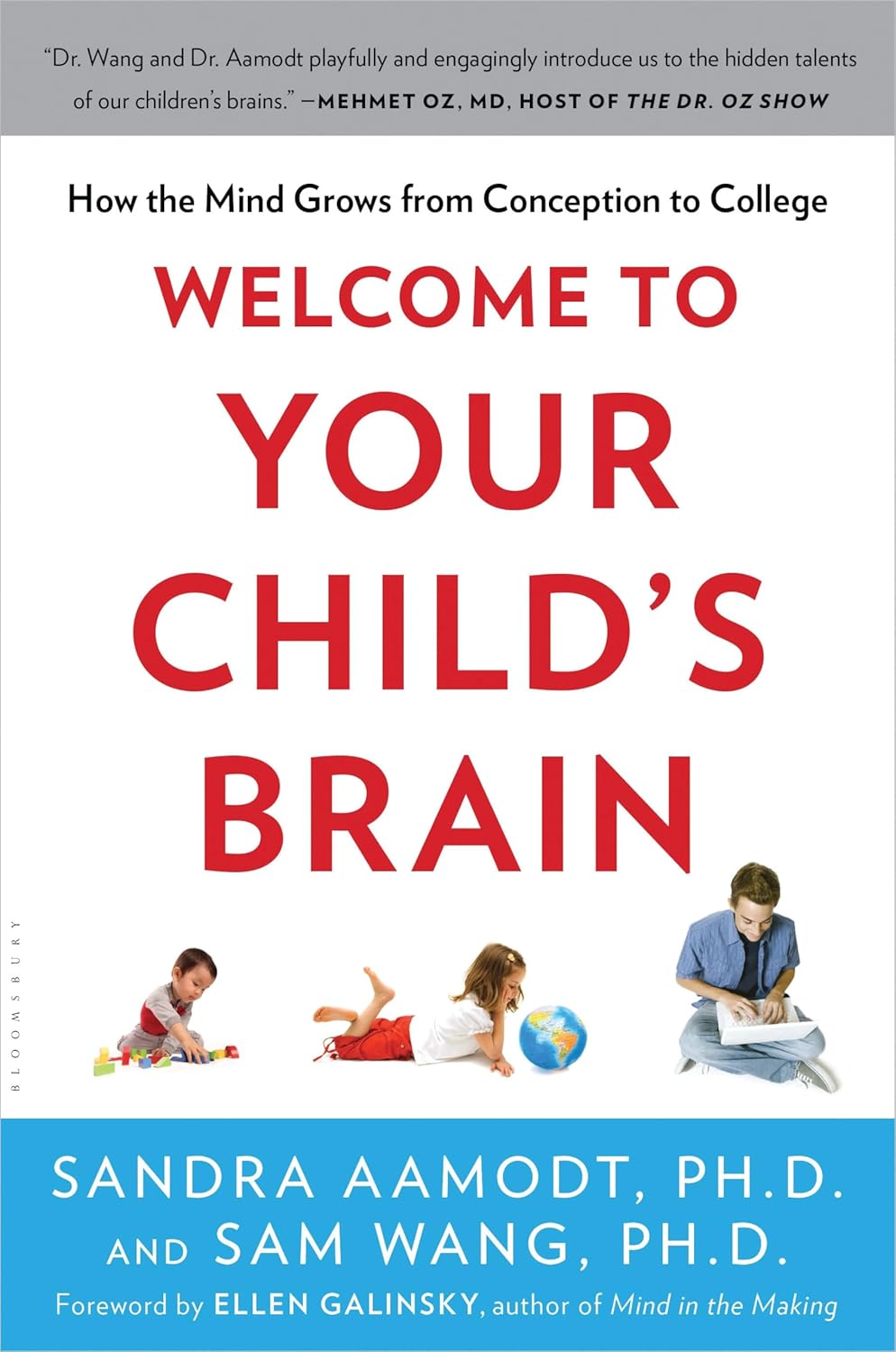
Welcome to Your Child’s Brain: How the Mind Grows from Conception to College
$14.59
Price: $14.40 - $14.59
(as of Aug 18, 2025 05:33:12 UTC – Details)
How children think is one of the most enduring mysteries–and difficulties–of parenthood. The marketplace is full of gadgets and tools that claim to make your child smarter, happier, or learn languages faster, all built on the premise that manufacturers know something about your child’s brain that you don’t. These products are easy to sell, because good information about how children’s minds really work is hard to come by.
In their new book, neuroscientists Sandra Aamodt and Sam Wang separate fact from fiction about the inner workings of young minds. Martialing results from new studies and classic research, Aamodt and Wang provide the most complete answers out there on this subject. It liberates readers from superstitions and speculation, such as Freud’s idea that all relationships are modeled on one’s mother, or that it’s not safe to eat sushi while pregnant. And it will reveal new truths about everything from how to make your baby sleep, to why we love to snuggle, to how children learn, forget, play, talk, walk, and feel.
Welcome to Your Child’s Brain is eye-opening and necessary, soon to become a staple for parents and children alike.
ASIN : B005PWMG7S
Publisher : Bloomsbury USA
Accessibility : Learn more
Publication date : September 20, 2011
Edition : 1st
Language : English
File size : 7.6 MB
Screen Reader : Supported
Enhanced typesetting : Enabled
X-Ray : Not Enabled
Word Wise : Enabled
Print length : 338 pages
ISBN-13 : 978-1608197408
Page Flip : Enabled
Best Sellers Rank: #1,555,663 in Kindle Store (See Top 100 in Kindle Store) #532 in Medical Adolescent Psychology #696 in Adolescent Psychology (Kindle Store) #709 in Child Development
Customer Reviews: 4.6 4.6 out of 5 stars 115 ratings var dpAcrHasRegisteredArcLinkClickAction; P.when(‘A’, ‘ready’).execute(function(A) { if (dpAcrHasRegisteredArcLinkClickAction !== true) { dpAcrHasRegisteredArcLinkClickAction = true; A.declarative( ‘acrLink-click-metrics’, ‘click’, { “allowLinkDefault”: true }, function (event) { if (window.ue) { ue.count(“acrLinkClickCount”, (ue.count(“acrLinkClickCount”) || 0) + 1); } } ); } }); P.when(‘A’, ‘cf’).execute(function(A) { A.declarative(‘acrStarsLink-click-metrics’, ‘click’, { “allowLinkDefault” : true }, function(event){ if(window.ue) { ue.count(“acrStarsLinkWithPopoverClickCount”, (ue.count(“acrStarsLinkWithPopoverClickCount”) || 0) + 1); } }); });
Customers say
Customers find the book very informative, particularly noting its wealth of information about child development and its value as a resource for parents of young children. The language receives mixed feedback, with some customers finding it well written while others note it can be technical at times.
9 reviews for Welcome to Your Child’s Brain: How the Mind Grows from Conception to College
Add a review
Related Products



$14.59

Ria –
Informative about development
I have read this book and refer to it sometimes. I recommend this for anyone that works with kids such as teachers, as well as parents. It helps you place a child’s development in context. I bought this copy of this book to give to a new foster parent who is worried about her foster children’s development. I know she will like it.As usual with the last 6 or more books I’ve bought from Amazon, the cover was dirty with strange smears on it, and I had to clean it. I’m really tired of how gross the books arrive and I don’t know where or how to properly complain about this. This doesn’t affect my rating of this book though, it’s not the author’s fault that Amazon can’t get their act together.
Findion –
An accessible up-to-date description of how a child’s brain develops from before birth though early adulthood.
I have to say I enjoyed this book a lot. As the father of a 6-month-old, it’s been amazing to watch my daughter pass some of the big developmental milestones at the same time I am reading about changes that are (or will be) going on in her brain as she grows up.To me, “Welcome to Your Child’s Brain” really stands out for two reasons:1. The authors clearly and concisely summarize results from the current scientific literature without resorting to the over-simplification of this topic that I sometimes see on talk-shows or even in other books.2. Although the book is a fascinating read on its own, it also contains a lot of useful information. I definitely have a better idea of what (and what not) to worry about after reading it.I think it will be very helpful to have such an informed overview of the most recent science handy as my daughter gets older.
Deanna Smith –
Children are us
I thought this book was going to be difficult for me to read as an over 50 woman with no kids. However, I found it to be so light-heartedly scientific that I enjoyed it way more than anticipated. All of us were children once, so it is relevant even if you don’t have kids. My grandmother, when she was 82, told me that in her mind she was 17. Bathroom mirrors be damned. I love the way children can learn so quickly and I wonder can we learn from them?
Reading Comets –
Great tips for parents, with one exception>
I really enjoyed this book and it is a very good resource for parents of young children. While most of the information is on target, the authors miss the target and the point when they say babies can Not learn to read. Tens of thousands of parents have direct proof that the authors statement on baby reading is incorrect. Here is a link to a […] blog by one of the nations top reading experts who disagrees and provides a sound argument for why parents should begin the reading learning process at birth. Since outside links to sites are not allowed by Amazon, just do a search for the following title for the blog post to see a review of this book and why the authors are incorrect about baby reading.Baby/Toddler Reading: What Neuroscientists and Parents Need to Know:[…]Otherwise, I found the book useful and would recommend it. For information on baby reading, try Dr. Richard Gentry’s book for parents: Raising Confident Readers: How to Teach Your Child to Read and Write–from Baby to Age 7
Jay L –
New concepts in neuroscience and parenting
I’ve read about a dozen books on neuroscience and parenting. Your Child’s Brain covered a lot of new ground in these 2 areas. Of course, there are methods and research that I’ve seen in other books, but I was pleasantly surprised at the amount of new information. I would classify this book as a must read, especially is you are a strict parent like me (I/we need to back off a bit).
Dennis Coates –
For parents? A thorough, responsible treatment, but technical and scholarly
Parents desperately need to know about their child’s brain, because there are sensitive windows of development with outcomes that last a lifetime. Parents have work to do at certain times, and they need to know what it is.One thing I liked about this book is that it’s thorough and responsible…all the stages, all the science is up-to-date. The authors have studied and worked in neuroscience for years. I’m an avid read of books like this, and I loved the extensive glossary, the hundreds of scientific references, and the detailed index. I appreciated this book far more than the pop science treatments of the developing brain that get a lot of the science wrong.But all this rigor is actually a problem. It’s as if the authors wanted to write a book for parents and ended up writing a book for other scholars and scientists. For example, the development of the prefrontal cortex happens during adolescence and is hugely important to the development of the basic structure of a child’s intellect. Here’s some of what the authors have to say about it:”In a longitudinal study of children, the pattern of developmental changes in cortical thickness predicted intelligence more strongly than did the adult configuration at age twenty….Dendritic branching in neurons was also correlated with intelligence in a few studies.”This is a technically accurate description of the research. But what does this mean to a parent? Nothing.The problem is the authors know their business but they’ve been writing for scientific peer review for decades, and so this is how they like to write about the topic. But this kind of writing doesn’t communicate to parents. There are some important, practical points to be made, and these are buried in this kind of review of research.I think few parents will be able to wade through all this technical description, but if they do they’ll be convinced that there are stages of brain development that are important to the successful growing up of their child. But aside from being aware, what should they do as parents? There’s not much of this in the book, and what’s here is hard to find among the 300 pages of responsible scientific journalism.
Seattle Mom –
Worth reading BEFORE you have kids
It isn’t exactly what you will be reading when your brain is frazzled once the baby arrives, but it offers practical advice for how to help your child learn. If you are pro screen time, you won’t like this book. This book also encouraged us to introduce my daughter to Spanish before 6 months and she LOVES it.
Olesya Barrett –
Great book for those parents who like science-based books. It is very well written and has actual references to current research on the topic.
Gaelle –
I thought it was going to talk more about the psychology of a child rather than the physical side of things