

Disconnected: How to Protect Your Kids from the Harmful Effects of Device Dependency
Original price was: $18.00.$13.24Current price is: $13.24.
Price: $18.00 - $13.24
(as of Aug 13, 2025 22:34:25 UTC – Details)
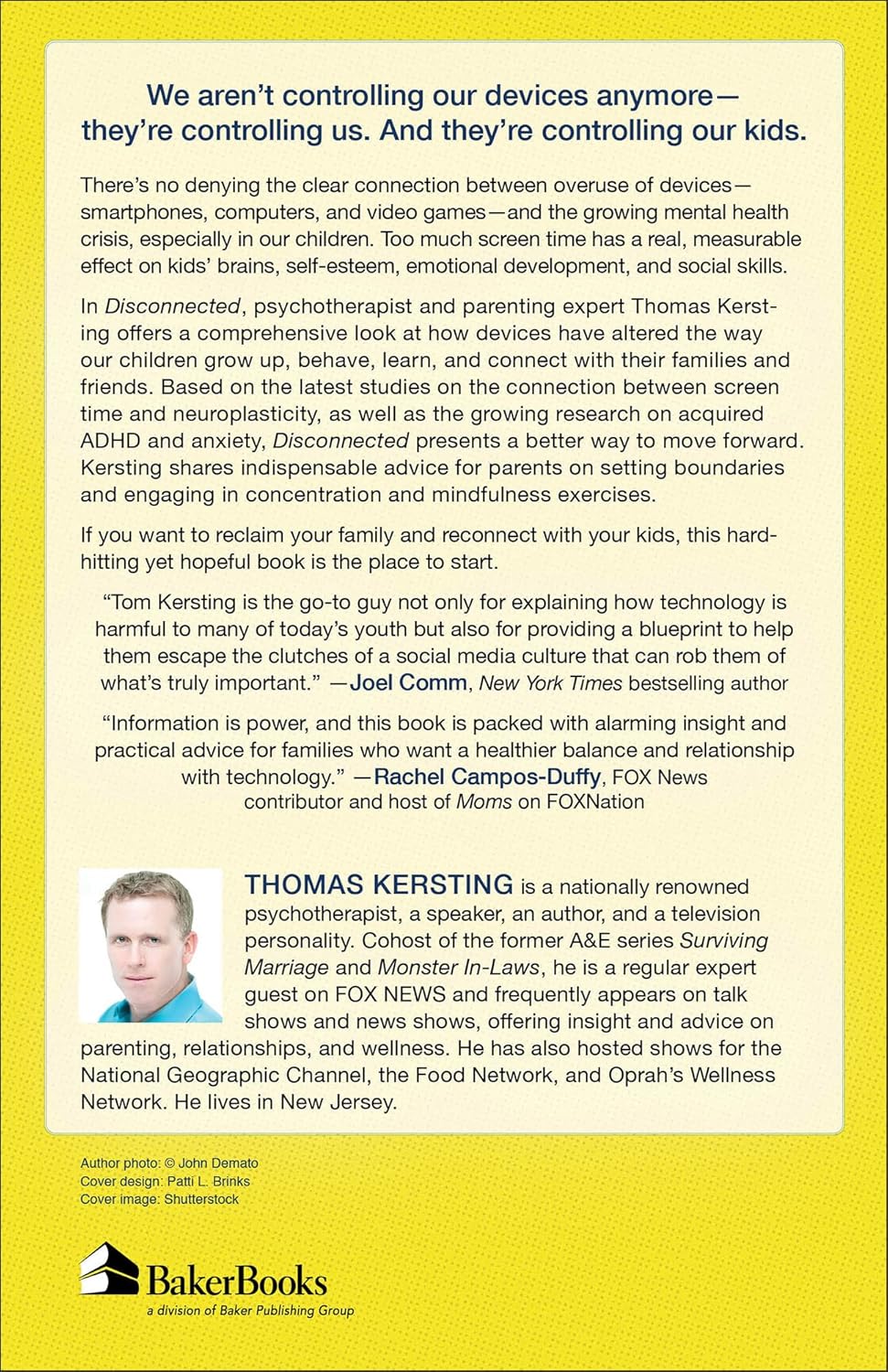
There’s no denying the clear connection between overuse of devices–smartphones, computers, and video games–and the growing mental health crisis, especially in our children. Too much screen time has a real, measurable effect on kids’ brains, self-esteem, emotional development, and social skills. We aren’t controlling our devices anymore–they’re controlling us.
In Disconnected,psychotherapist and parenting expert Thomas Kersting offers a comprehensive look at how devices have altered the way our children grow up, behave, learn, and connect with their families and friends. Based on the latest studies on the connection between screen time and neuroplasticity, as well as the growing research on acquired ADHD and anxiety, Disconnected presents a better way to move forward. Kersting shares indispensable advice for parents on setting boundaries and engaging in concentration and mindfulness exercises.
If you want to reclaim your family and reconnect with your kids, this hard-hitting yet hopeful book is the place to start.
From the Publisher

The Harmful Truth


Publisher : Baker Books
Publication date : August 4, 2020
Language : English
Print length : 208 pages
ISBN-10 : 1540900304
ISBN-13 : 978-1540900302
Item Weight : 10.5 ounces
Dimensions : 5.5 x 0.47 x 8.5 inches
Best Sellers Rank: #451,901 in Books (See Top 100 in Books) #151 in Parenting Teenagers (Books) #159 in Computer History & Culture (Books)
Customer Reviews: 4.6 4.6 out of 5 stars 484 ratings var dpAcrHasRegisteredArcLinkClickAction; P.when(‘A’, ‘ready’).execute(function(A) { if (dpAcrHasRegisteredArcLinkClickAction !== true) { dpAcrHasRegisteredArcLinkClickAction = true; A.declarative( ‘acrLink-click-metrics’, ‘click’, { “allowLinkDefault”: true }, function (event) { if (window.ue) { ue.count(“acrLinkClickCount”, (ue.count(“acrLinkClickCount”) || 0) + 1); } } ); } }); P.when(‘A’, ‘cf’).execute(function(A) { A.declarative(‘acrStarsLink-click-metrics’, ‘click’, { “allowLinkDefault” : true }, function(event){ if(window.ue) { ue.count(“acrStarsLinkWithPopoverClickCount”, (ue.count(“acrStarsLinkWithPopoverClickCount”) || 0) + 1); } }); });
Customers say
Customers find the book incredibly informative, with good research supporting its content. Moreover, they consider it a must-read for parents and accessible to both parents and kids. Additionally, customers appreciate its concise length.
10 reviews for Disconnected: How to Protect Your Kids from the Harmful Effects of Device Dependency
Add a review
Related Products



Original price was: $18.00.$13.24Current price is: $13.24.

Frisco Texans –
If you “think” your child is addicted to the phone, they are! Get this book right now! This is an epidemic ruining our youth.
Wow! All the things I suspected about smart phone usage for teens/kids is validated in this book by solid research. The evidence is overwhelming that even in small doses of this shiny object can cause irreversible harm to our children (and parents).This is a difficult discussion to have with my teenage (age 13) daughter because I use a smart phone too. It’s not like a drug addict that you can confront because you don’t do drugs.This is an eye opener that any parent or non-parent should read. It’s useful for adults who use a smart phone non-stop.I discussed this book with my daughter (13 years old and 8th grade) and she got quite defensive saying she wasn’t addicted as she fumbled for her phone. She stated that she could hold a conversation and then named off 4 of her classmates at school who couldn’t hold a conversation. She reluctantly admitted those 4 kids are on their phones non-stop at lunch and before/after school.This book opened up the discussion as how serious this problem is and how it’s impacting everyone. When I put it in the context of her friends at school and her generation vs. blaming her – it seemed to get through. I told her we are losing an entire generation of young people to this epidemic. It’s as serious as the opioid crisis although people aren’t experiencing physical death, they are experiencing emotional/social death.I asked her this question: “Guess what my biggest regret as a parent is?” – of course she said “What?”. I said “Getting you a phone.” That did cause her to stop and think for a moment. She didn’t ask “Why do you regret it?” – she instinctively knew why.If your child does not have a phone do NOT get him/her a phone. Please, I beg you! This is by far the biggest mistake I ever made as a father and I regret it daily. Once you open the Pandora’s box – game over!I read out-loud the first chapter of this book to my daughter. Boy, she did NOT want to hear it although she listened. After I read the first chapter, I then challenged her to provide me proven research that smart phone use is good for teens.The case is clear that this technology is no longer interrupting our lives, it’s ruining our lives. I’m not one to go around ringing alarm bells but moms and dads, we have a crisis on our hands and it’s only getting worse. We must demand there be some legislation to stop phone usage with minors – it’s more lethal than drugs and alcohol. It’s not a joke.I did purchase the paperback version of this book. Something didn’t seem right about reading this book on a Kindle.
jdelgado –
This book gives so much insight. Amazing.
This book has really helped me with a troubled teenage daughter. I have taken her off of her phone as much as possible and the difference is unbelievable. If you have kids this book is a must read. He not only explains the detrimental things that happen to the brain from it but, gives you ideas and instruction on how to approach it to get your kids back to a healthy life.
Amy –
Helped me feel confident in setting limits for my kids (and myself!)
As a parent of four kids, I have always had a vague, nagging understanding that I need to limit their screentime, but this book gave me the facts I needed to feel confident in the limits I set for them. It has lots of practical, concrete steps you can take to help your kids (and yourself!) develop a healthy relationship with devices. Definitely one I will keep and refer back to as my kids get older and we encounter new stages of parenting.
Book Glutton –
What is media doing to your children? Read this book! Highly recommended!
This is highly recommended! Everybody is somehow dealing with family members, especially children and teens that seem to fall into the category of having ADHD, being anxiety ridden, distracted, and/or possessing maybe other like symptoms. Psychoanalyst Tom Kersting, who I’ve seen in some very interesting TV interviews is linking a lot of this stuff to overuse of electronic media, video games, handheld devices, and TV is not left out of this. It didn’t take much to identify a lot of what he claims with behaviors that are easily witnessed or have spoken about by parents who have explain their bewilderment of some behavioral problems they are witnessing in their children. I have recommended, if possible, that they read this book and get some sort of grip on this whole thing. When they question what good that will do, I have read the following short excerpt from the book. It quickly becomes a wake-up call for them because they readily identify with Kersting’s reasoning and conclusions. He says:Here are some warning signs that your child is spending too much time using any form of electronic media, including television, video games, handheld devices, and computers/tablets.– Loses track of time when using electronic devices– Becomes agitated when interrupted– Prefers to spend time using electronics rather than being with friends or family in person– Does not follow time limits– Forms relationships with people online– Loss of interest in other activities– Seems restless when not using a device and preoccupied with getting back on– Avoids homework and chores because of spending too much time with electronics– Sneaks on a device when no one is around and lies about itIf your child exhibits any of these signs, you will need to step in. The best way to address any of these issues is to sit down with your child and express your concerns. Next, set strict guidelines for your child to follow and make it clear that if he or she violates them that there will be consequences. Guidelines might include no electronics in the bedroom, no video games during the week, no smartphones in the car or during dinner, and mandatory unplugging times. Should your child violate any of the guidelines you must hold him accountable and follow the consequences you prescribed. Consequences might include removing the television from the bedroom, taking away the cellphone for a week, or unplugging the video game console for a period of time. Consistency is the key. I will discuss how to help your children (and yourself!) cut down on electronic media consumption in greater detail in Part Three of this book.
AHorne –
Warning!!
Grandparents, if you have the feeling that your grandchildren and/or their parents are immersed in electronic gadgets, you must read Disconnected. It is a straight forward account of the specific reasons that support your feelings. In fact, this book explains how these devices are robbing your grandchildren of crucial developmental processes, including independent critical reading, thanking, and expression within the relative safety of the family. Further they are being conditioned in groupthink that endangers meaningful functioning in the real world. Are you contributing to the problem by your example of Facebook addiction or apathy? What do you do with this information is up to you. Kersting has it nailed.ANDY, A Grandad
adam –
This is a general rant about things not being as good for children now as they used to be. Basically saying that we would be better off without technology. Whether that is right or not it is not an option open to parents as we cannot un-invent phones or social media. The positive suggestions in the book are meditation and seeing boredom as a positive influence. Both are great ideas as far as they go. There is still a need for experts in this area to have creative practical suggestions for concerned parents.
William –
I was impressed with the authorâs research and experience on the subject matter. Digital screen time and more specifically Smart Phone technology is perverting the culture in insidious ways. SocialMedia turns out to be an oxymoron because of the increasing isolation of its users. I found the book to be thought provoking but ended up wish Mr. Kerting had been more proscriptive about how society should deal with it. Ignoring the problem seems to me to be a recipe for social Balkanization and societal chaos never mind the irreparable damage being done to younger and upcoming generations.
Hans Michael Wienhold –
Smartphones, social media, beeps and likes, life experienced through a screen is possibly causing more damage than tobacco. Everyone, not just parents, should read this book.
Monika E. Schloder –
Excellent but scary to see the new generation getting so addicted and mentally disfunctional!
cathy Knott –
Are you kidding me? I wanted this as a book and I get it as Amazon Digital which is kindle. I wanted a book to show my kids that my grandchildren should not be playing computer games at age 2. I wanted to convince them that 8 years of age should not have cell phones or spend hours and hours on computers. Instead I get a kindle addition. Seriously. I am so disgusted.